
Instagram SEO: A Complete Guide for Small Businesses

Instagram is no longer simply a place where people scroll through photographs.
It has become a place where people look for things.
They search for restaurants, jewellery brands, photographers, designers, skincare recommendations, travel ideas, artists, events and businesses they have never encountered before.
That changes the question businesses should be asking.
It is no longer only:
“How do we get people to see our Instagram posts?”
It is also:
“When someone is looking for what we offer, can they find us?”
This is where Instagram SEO comes in.
Instagram SEO is the practice of making your profile and content easier for Instagram to understand and easier for people to discover through search. Keywords, profile information, captions, hashtags and other signals help Instagram understand what your content is about, while engagement and user behaviour can influence what appears more prominently.
For small businesses especially, this creates an interesting opportunity.
You don’t necessarily need the largest following in your industry.
You need to become discoverable to the right people.
What Is Instagram SEO?
Instagram SEO, or Instagram search engine optimization, is the process of optimizing your Instagram presence so that your account and content can be discovered when people search for relevant topics, products, services or places.
Think of it as giving Instagram enough context to answer three questions:
What is this account about?
Who is it relevant to?
What searches or interests should it appear alongside?
For example, imagine you run a small jewellery brand in Kochi.
You could describe your business in creative language:
“Objects for the romantically inclined.”
It might sound beautiful.
But it doesn’t tell a search engine much.
Compare it with:
Handmade jewellery in Kochi | Contemporary jewellery & slow fashion
The second version gives Instagram considerably more information about what the account actually offers.
Creativity can attract people. Clarity helps them find you.
That’s an important principle in Instagram SEO.
Why Instagram SEO Matters for Small Businesses
Large brands can spend heavily on advertising and influencer campaigns.
Small businesses often have to work differently.
Organic discovery can help you reach people who are already looking for something related to what you sell.
Someone searching for:
- handmade jewellery
- ceramic studio
- Kochi cafés
- sustainable fashion
- wedding photographer
- art exhibitions
- skincare for sensitive skin
isn’t simply consuming content.
They are expressing intent.
They have a question, interest or potential need.
That makes search-driven discovery particularly valuable.
Instagram itself has explained that Search uses the text someone enters to match relevant usernames, bios, captions, hashtags and places, alongside activity and popularity signals.
The goal, therefore, isn’t to “hack the algorithm.”
It is to make the relationship between what people search for and what your business offers clearer.
1. Start With What Your Audience Actually Searches For
Before changing your Instagram bio, make a keyword list.
But don’t begin with:
“What sounds good for my brand?”
Begin with:
“What would my customer type into Instagram if they didn’t know my brand existed?”
This distinction matters.
A photographer might describe themselves as a:
“Visual storyteller.”
But a potential customer might search:
“wedding photographer Kochi”
A jewellery founder might call their work:
“Contemporary adornment.”
Their customer might search:
“minimal jewellery India”
The second set of phrases is much more useful for search optimization.
Build your keyword list around:
What you sell
jewellery, skincare, photography, clothing, ceramics
Who you serve
brides, small businesses, artists, students, travellers
What problem you solve
gift ideas, wedding photography, social media management
Where you operate
Kochi, Mumbai, Bengaluru, India
What makes you different
handmade, sustainable, independent, luxury, affordable, contemporary
The language your audience uses should influence the language your profile uses.
2. Optimize Your Instagram Name and Bio
Your Instagram profile is one of the clearest places to communicate what your business actually does.
Your username, name field and bio should work together rather than repeating the same information.
For example:
Instead of:
Name:
Ameena’s Things
Bio:
Creating beautiful things for beautiful people ✨
Try:
Name:
Ameena | Handmade Jewellery
Bio:
Contemporary handmade jewellery in Kochi
Slow-made pieces inspired by everyday objects
↓ Shop the collection
The second version still has personality.
But it also gives Instagram — and a potential customer — useful information.
Current Instagram SEO guidance specifically recommends incorporating relevant keywords into searchable profile information, while keeping the language natural and useful to the audience.
A useful formula:
Name: What you are / what you offer
Bio: What you do + who it’s for + location or differentiator
Link: Where you want the visitor to go next
3. Use Keywords Naturally in Your Captions
Your caption is not just a place to say:
“New drop ✨”
It is also an opportunity to explain what the content is about.
Imagine you’re posting a photograph of a handmade silver ring.
Instead of:
“A little something for your everyday ✨”
You could write:
“Our new handmade silver ring is designed for everyday wear — a minimal jewellery piece inspired by the textures of Kerala’s coastal landscape.”
Now the caption naturally contains context around:
handmade silver ring · minimal jewellery · everyday jewellery · Kerala
That’s considerably more useful for both humans and search.
Instagram SEO isn’t about turning captions into keyword lists.
It is about writing clearly enough that the subject of your content is unmistakable.
Current guidance similarly recommends weaving keywords into captions naturally rather than forcing repetitions into the copy.
4. Think About Search Intent, Not Just Keywords
This is where Instagram SEO starts becoming more interesting.
Consider the difference between:
“jewellery”
and
“minimal gold jewellery for everyday wear.”
The second search tells you much more about what the person wants.
Good content responds to that intention.
For example:
| Search | Possible content |
|---|---|
| handmade jewellery | Behind-the-scenes making process |
| jewellery styling | “3 ways to style a silver chain” |
| jewellery gift ideas | Gift guide |
| minimal jewellery | Product collection |
| jewellery care | Jewellery care tutorial |
| jewellery in Kochi | Local brand / studio story |
This is why keyword research and content strategy shouldn’t be separate activities.
The search query can become the idea.
5. Don’t Ignore Alt Text
Alt text is primarily an accessibility feature: it helps describe visual content to people who use screen readers.
But it can also provide additional context about an image.
If you are posting a photograph of a handmade ceramic vase, your alt text could describe it accurately:
“Handmade white ceramic vase with blue painted details on a wooden table.”
If a relevant keyword genuinely belongs in that description, include it.
What you shouldn’t do is turn alt text into:
“ceramic vase handmade ceramics pottery home décor ceramic studio pottery India ceramic vase India…”
That isn’t useful to anyone.
Describe the image first. Optimize second.
6. Use Hashtags as Context, Not a Keyword Dump
Hashtags still have a role in content discovery and categorisation, but they shouldn’t be treated as the entire Instagram SEO strategy.
Instead of adding dozens of loosely related hashtags, choose tags that genuinely describe:
- Your industry
- Your niche
- Your product
- Your location
- Your community
For a Kochi-based independent jewellery brand, that might mean using a focused combination around jewellery, handmade design, slow fashion and Kochi rather than attaching every trending hashtag imaginable.
The broader principle is simple:
Relevance beats volume.
Current Instagram SEO guidance continues to recommend relevant hashtags alongside keywords, while warning against stuffing.
7. Use Location When Location Matters
For local businesses, location can be a powerful discovery signal.
A café in Kochi isn’t competing for the same search intent as a café in Delhi.
If location is genuinely important to your business, make it visible in appropriate places:
- Profile
- Captions
- Location tags
- Content
- Relevant hashtags
For example:
“A small independent bookstore in Fort Kochi…”
is much more informative than:
“Your new favourite place 📚”
The second might sound more poetic.
The first tells potential customers where you are and what you are.
You can still have both.
8. Build Content Around Searchable Questions
One of the easiest ways to make Instagram content more discoverable is to answer questions people actually have.
Instead of creating content only around your products, think about the questions surrounding them.
A skincare brand could create:
- How should you layer skincare?
- What is the difference between SPF 30 and SPF 50?
- How often should you exfoliate?
A jewellery brand:
- How do you clean silver jewellery?
- How should you style layered necklaces?
- What jewellery makes a good gift?
A photographer:
- What should you wear for a photoshoot?
- How much does a wedding photographer cost?
- How do you choose a wedding photographer?
This transforms your Instagram from a display window into a useful resource.
And useful resources tend to give people more reasons to save, share and return.
9. Create Content Around a Clear Topic
Instagram needs to understand what your account is about.
If Monday is skincare, Tuesday is football, Wednesday is real estate and Thursday is obscure Renaissance painting memes, your content may be entertaining — but your topical identity becomes harder to understand.
This doesn’t mean your account needs to become painfully repetitive.
It means your content should have recognisable territories.
For example, a fashion brand might consistently talk about:
Fashion · Styling · Materials · Brand Story · Culture
A jewellery brand:
Jewellery · Styling · Craft · Materials · Design
A cultural organisation:
Art · Artists · Events · Ideas · Community
These recurring themes become your content pillars.
They also give you a natural pool of related keywords.
10. Think in Keyword Clusters
One keyword rarely represents an entire business.
Imagine your primary topic is:
Handmade jewellery
Related topics might include:
- handmade jewellery India
- handmade jewellery Kochi
- silver jewellery
- minimal jewellery
- sustainable jewellery
- jewellery styling
- jewellery care
- jewellery gift ideas
You can build individual posts around these topics.
Over time, your account develops a stronger association with the broader subject.
This is similar to the logic behind traditional SEO: instead of producing one page that tries to rank for everything, you build useful content around connected search intents.
11. Make Reels Searchable Too
Reels are not separate from your discovery strategy.
The content itself still needs to communicate what it is about.
For example, instead of opening a Reel with:
“Come with me…”
you could open with:
“3 ways to style minimal jewellery for everyday outfits.”
Now the viewer immediately understands the subject.
Your spoken words, on-screen text and caption can reinforce the topic naturally.
And SEO is only one part of Reel discovery. Current Instagram guidance also points to behavioural signals such as watch time, shares and interactions when considering how content is recommended.
So don’t sacrifice an interesting video just to squeeze a keyword into it.
Search gets someone to the door. Good content gives them a reason to stay.
12. Don’t Chase Every Trending Keyword
There is a temptation to see a trending topic and attach it to your content.
Resist it.
If you’re a jewellery brand and suddenly start posting about something completely unrelated because it’s trending, you may get temporary attention but weaken your content’s overall coherence.
Instead, ask:
“Is there a genuine connection between this trend and what my audience cares about?”
If yes, use it creatively.
If not, let it pass.
A strong brand does not need to participate in every conversation.
13. Make Your Content Worth Finding
This is the part people sometimes forget when talking about SEO.
Optimization can help people find content.
It cannot make mediocre content meaningful.
If two accounts use the same keyword, the one that consistently creates content people actually want to watch, save, share or follow has a much stronger foundation.
Instagram’s current recommendation systems use different signals across surfaces, with engagement and user behaviour playing an important role alongside relevance.
So ask of every post:
Would someone save this?
Would someone send it to a friend?
Does it answer something?
Does it show something they haven’t seen?
Does it make them feel something?
Does it make them understand the brand better?
That’s where SEO meets actual communication.
14. Track What People Discover You Through
Instagram SEO shouldn’t be something you “set and forget.”
Look at your account’s analytics and pay attention to patterns.
Which posts attract non-followers?
Which topics generate profile visits?
Which content gets shared?
Which posts lead people to your website?
Which topics repeatedly perform well?
Then use those observations to shape your next round of content.
The process becomes:
Research → Create → Publish → Observe → Learn → Refine
Rather than:
Post → Hope → Panic → Post again
The second strategy is, unfortunately, how many social media calendars are born.
A Simple Instagram SEO Cheklist
Before publishing a post, ask:
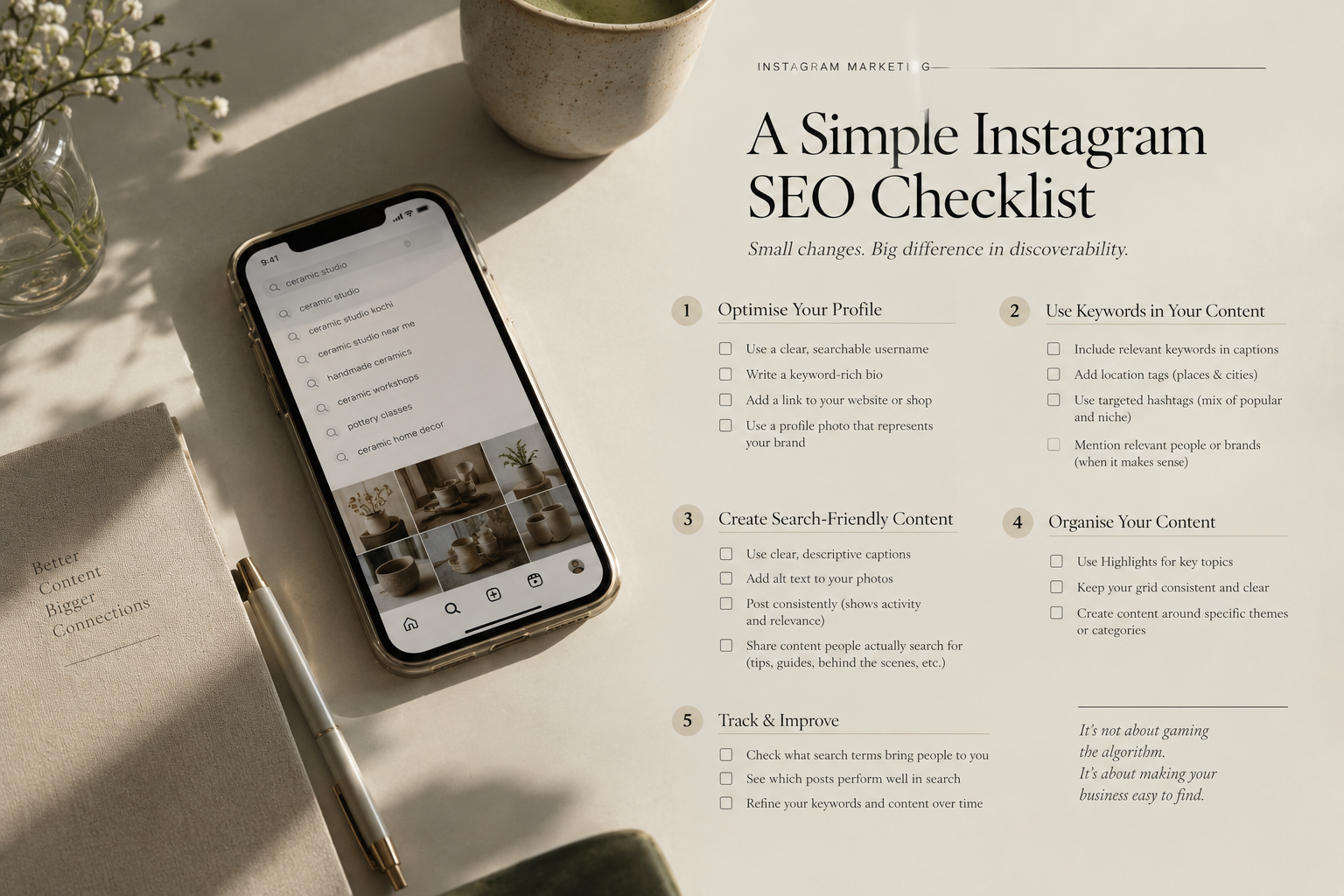
Profile
☐ Does my name clearly communicate what I do?
☐ Does my bio contain relevant terms my audience might search?
☐ Is my location included if it matters?
Content
☐ Does the post have a clear subject?
☐ Does the caption naturally mention the topic?
☐ Does the content answer a question, provide value or create interest?
Search
☐ What would someone search to find this?
☐ Have I used that language naturally?
☐ Are my hashtags relevant?
Accessibility
☐ Does my alt text accurately describe the image?
Strategy
☐ Does this fit one of my content pillars?
☐ Is this useful to the audience I actually want?
Measurement
☐ What would success look like for this post?
The Bigger Idea: Instagram SEO Is Really About Clarity
The best Instagram SEO strategy isn’t about trying to trick a platform into showing your content to more people.
It is about making meaning legible.
You know what your business is.
Your customers know what they’re looking for.
Instagram sits between the two, trying to understand whether your content is relevant.
Your job is to close that gap.
Use the language your audience actually searches for. Make your profile clear. Build content around genuine questions. Develop recognisable topics. Write captions that provide context. Use hashtags and locations with intention.
But don’t let optimization flatten your personality.
A handmade jewellery brand should still feel like a jewellery brand.
An artist should still sound like an artist.
A cultural organisation should still have a point of view.
SEO should make your creative work easier to discover — not make it sound like it was written for a search engine.
And perhaps that’s the most useful way to think about Instagram SEO:
Don’t create content for the algorithm and hope people find it. Create something worth finding, then make it easy to understand what it is.
FAQ: Instagram SEO
Does Instagram have SEO?
Yes. Instagram has its own search and recommendation systems that use signals such as search text, account information, captions, hashtags, places and user activity to determine relevant results.
How do I make my business searchable on Instagram?
Start by clearly describing your business in your searchable profile information, then use relevant keywords naturally in captions and content. Consistent topics, relevant hashtags and location information can also help Instagram understand your account.
Where should I put keywords on Instagram?
Useful places include your profile’s name and bio, captions and relevant hashtags. Keywords should describe the actual content rather than being inserted repeatedly for the sake of SEO.
Do hashtags help Instagram SEO?
They can help categorise and surface relevant content, but hashtags shouldn’t be treated as a substitute for a clear profile, useful content and natural keyword use.
How many hashtags should I use on Instagram?
There isn’t a universal number that guarantees better reach. Focus on relevance rather than filling your caption with every vaguely related hashtag.
Can small businesses benefit from Instagram SEO?
Absolutely. Search can help people discover businesses they don’t already follow, particularly when the business serves a specific niche, location or search intent.