
Posting consistently is often treated as the golden rule of social media.
Three posts a week.
Stories every day.
A Reel here.
A trend there.
And somehow, you’re supposed to magically grow.
But consistency without direction can quickly turn into posting for the sake of posting.
A social media strategy should answer a much more important question:
Why should someone want to follow this account in the first place?
Whether you’re building a personal brand, running a small business, managing a cultural organisation or working on a larger brand, social media works best when every piece of content has a reason to exist.
The goal isn’t simply to create more content.
It’s to create a recognisable world that people want to return to.
Here’s how I think about building that.
1. Start with the goal—not Instagram
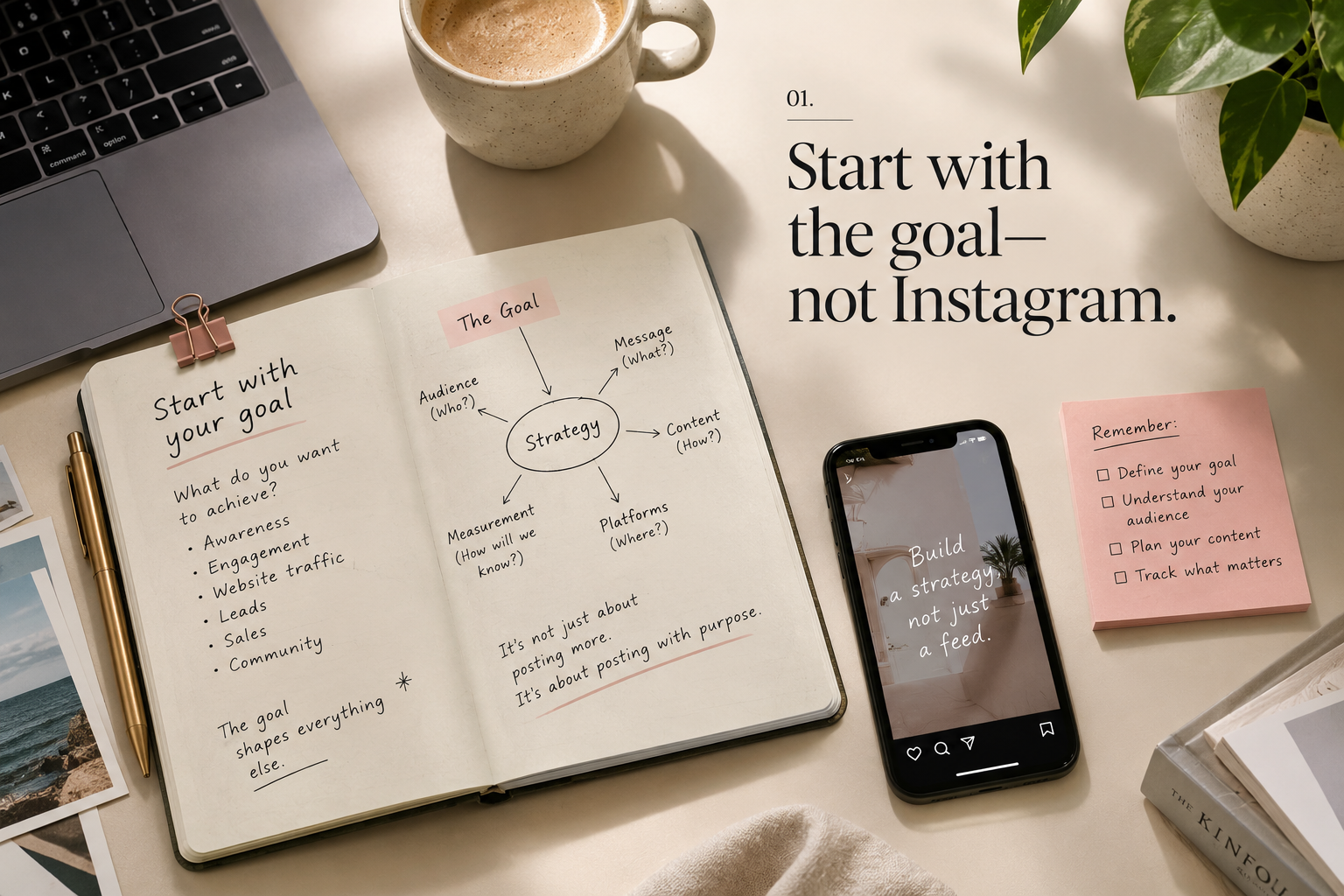
Before deciding what to post, decide what the account actually needs to achieve.
Different goals require different strategies.
A business might want:
- More enquiries
- More sales
- Brand awareness
- Website traffic
- Community building
A creator might want:
- A recognisable personal brand
- Audience growth
- Opportunities and collaborations
- Community
- Authority in a particular niche
A cultural organisation might want:
- Event discovery
- Audience participation
- Awareness of artists and programmes
- Ticket sales
- Community engagement
These aren’t interchangeable.
If the goal is selling tickets, getting 50,000 views on an unrelated meme isn’t necessarily success.
If the goal is building a community, constantly pushing promotional posts might actually work against you.
So the first question isn’t:
“What should we post?”
It’s:
“What are we trying to make happen?”
2. Know who you’re talking to
“Everyone” is not an audience.
A social media strategy becomes much clearer when you know who you’re trying to reach.
You don’t necessarily need an elaborate demographic profile.
Start with questions like:
Who would genuinely care about this?
What are they interested in?
What problems do they have?
What do they already follow?
What kind of content makes them stop scrolling?
What might make them trust this brand?
What would make them share something with a friend?
For a fashion brand, the audience might care about styling, identity, culture and aesthetics.
For a restaurant, it might be food discovery, atmosphere, convenience and social experiences.
For a film festival, the audience might care about filmmakers, stories, cinema culture, events and discovering something they wouldn’t find elsewhere.
The content changes because the reason people follow changes.
3. Give people a reason to follow
This is one of the biggest questions a social media strategy should answer.
Imagine someone discovers your account through one Reel.
They watch it.
They like it.
Then they visit your profile.
Why should they press Follow?
If the answer is unclear, you’ve created attention without creating an audience.
A strong account usually has some kind of promise.
It might be:
“You’ll discover independent films here.”
“You’ll find practical marketing advice here.”
“You’ll see how we make our products.”
“You’ll discover artists and ideas you probably haven’t encountered before.”
“You’ll get styling inspiration that actually fits your lifestyle.”
The promise doesn’t need to be written literally in the bio.
But people should be able to feel it from the content.
4. Build content pillars
Once you understand the audience and purpose, decide what kinds of things the account should consistently talk about.
These are your content pillars.
For example, a fashion brand could have:
EDUCATE
Styling tips, fabric knowledge, fashion history.
INSPIRE
Editorial imagery, references, moodboards, styling.
CONNECT
Founder stories, people, behind-the-scenes moments.
PROVE
Customer stories, craftsmanship, reviews.
SELL
Products, launches, offers and collections.
Now the account has structure.
Instead of waking up every Monday and asking:
“What should I post?”
you have a system for generating ideas.
5. Don’t make every post sell something
This is where many brand accounts become exhausting.
Every post says:
BUY THIS.
NEW DROP.
SHOP NOW.
LIMITED OFFER.
Eventually, the account starts feeling less like a place people want to spend time and more like a digital billboard.
People don’t follow brands because they enjoy advertisements.
They follow because the account gives them something.
That something might be:
- Information
- Inspiration
- Entertainment
- Identity
- Community
- Access
- Discovery
Selling still matters.
But promotional content works better when it exists within a larger world.
Think:
Value → Interest → Trust → Desire → Action
rather than:
Post → Sell → Post → Sell → Post → Sell
6. Give every piece of content a job
Not every post needs the same objective.
One post might be designed to reach new people.
Another might be designed to build trust.
Another might encourage conversation.
Another might drive people to a website.
Another might simply make someone remember the brand.
Before publishing, ask:
What is this post supposed to do?
For example:
Reel: introduce the brand to new people.
Carousel: teach something useful.
Founder video: build connection.
Behind-the-scenes post: show personality.
Customer story: build trust.
Product post: encourage purchase.
This makes content much more intentional.
7. Think beyond the individual post
One of the easiest ways to make social media feel disconnected is to treat every post as an isolated piece of content.
Instead, think about how posts work together.
Someone discovers you through a Reel.
They visit your profile.
They see another post that explains what you do.
Then they discover your story.
Then they see evidence that other people trust you.
Then they visit your website.
That’s a journey.
You can think about it as:
DISCOVER
“Who are these people?”
↓
UNDERSTAND
“What do they actually do?”
↓
CONNECT
“Do I like what they stand for?”
↓
TRUST
“Are they credible?”
↓
ACT
“Do I want to buy, attend, subscribe, follow or enquire?”
A social media strategy becomes much stronger when content is designed around that journey.
8. Trends are tools, not a strategy
Trends can be useful.
They can increase discoverability, make content feel culturally relevant and give creators a format to work with.
But following every trend doesn’t automatically create a strong brand.
If a trend doesn’t fit the brand, it can actually make the account feel less distinctive.
The better question isn’t:
“What trend should we copy?”
It’s:
“Is there a way to use this format to say something that belongs to us?”
The trend is the format.
The idea is the identity.
9. Make the content recognisable
Imagine someone sees your post without seeing your username.
Would they know it came from you?
Recognition doesn’t necessarily mean putting the same graphic template on everything.
It can come from:
- The tone of writing
- The subjects you talk about
- Visual language
- Editing style
- Recurring formats
- Photography
- Colour
- Typography
- Humour
- The way you tell stories
The strongest brands don’t necessarily look identical in every post.
They feel like they belong to the same world.
That’s a much more interesting goal than making every post look like a template.
10. Make content people want to save or share
Likes are nice.
But some forms of engagement tell you much more about why people found something valuable.
A person might save something because:
“I’ll need this later.”
They might share it because:
“This is literally you.”
Or:
“You need to see this.”
Or:
“This explains exactly what I’ve been thinking.”
That means useful content doesn’t always need to be educational in the traditional sense.
A relatable observation can be shareable.
A checklist can be saveable.
A strong opinion can start a conversation.
A beautiful image can create desire.
A useful tutorial can solve a problem.
Ask:
Would someone do something with this content after seeing it?
That’s often a better question than simply asking whether they might like it.
11. Use social media to learn about your audience
One of the best things about social media is that it’s not just a broadcasting platform.
It’s also feedback.
Comments can reveal questions you hadn’t considered.
Shares can show what people find relatable.
Saves can indicate usefulness.
Replies can reveal language your audience naturally uses.
Analytics can show which formats attract attention and which ones don’t.
Instead of treating performance data as a report you look at once a month, use it to influence what you create next.
The process becomes:
Create → Observe → Learn → Adjust → Create again.
That’s a strategy.
Not just a content calendar.
12. Don’t confuse attention with connection
A post going viral can be exciting.
But viral attention isn’t automatically valuable.
Imagine a small sustainable fashion brand makes a funny Reel unrelated to fashion.
It gets two million views.
Amazing.
But the new viewers aren’t interested in sustainable fashion.
They don’t visit the website.
They don’t engage with future posts.
They don’t buy anything.
The number looks impressive.
The actual business impact might be minimal.
This is why I think the more useful question is:
Are we reaching the right people?
A smaller audience that genuinely cares about what you do can be far more valuable than a huge audience that doesn’t.
13. Social media should connect to something bigger
An Instagram account shouldn’t have to carry the entire brand.
It can lead somewhere.
To a website.
A newsletter.
A store.
An event.
A community.
A portfolio.
A YouTube channel.
A booking page.
A physical space.
For example, a cultural organisation might use Instagram to create curiosity around an artist, while the website provides the deeper programme information.
A brand might use Instagram to create desire, while its website handles the actual purchase.
A creator might use Instagram for discovery, while YouTube provides longer-form storytelling.
Each platform can have a role.
Social media becomes more powerful when it is part of an ecosystem rather than the entire strategy.
14. Build a system you can actually maintain
A strategy that looks beautiful on paper but takes 40 hours a week to execute isn’t necessarily a good strategy.
Think about your actual resources.
How many people are creating the content?
How much time do they have?
Do they have access to photography or video?
Can someone appear on camera?
What can realistically be produced every week?
What can be repurposed?
For example:
One interview could become:
- A long-form article
- A Reel
- Three quote posts
- A carousel
- Stories
- A newsletter section
The goal isn’t to squeeze every possible post out of one idea.
It’s to extend the life of good ideas.
15. Measure what actually matters
There isn’t one universal social media metric.
Choose measurements based on the goal.
If you’re trying to build awareness:
Reach · Impressions · Profile visits
If you’re trying to build engagement:
Comments · Shares · Saves · Replies
If you’re trying to drive traffic:
Link clicks · Website visits
If you’re trying to generate sales:
Leads · Conversions · Revenue
And if you’re building a community:
Returning viewers · Conversations · Participation · Community growth
The numbers are useful when they help you make a decision.
Otherwise, they’re just numbers.
A simple framework for building your social media strategy
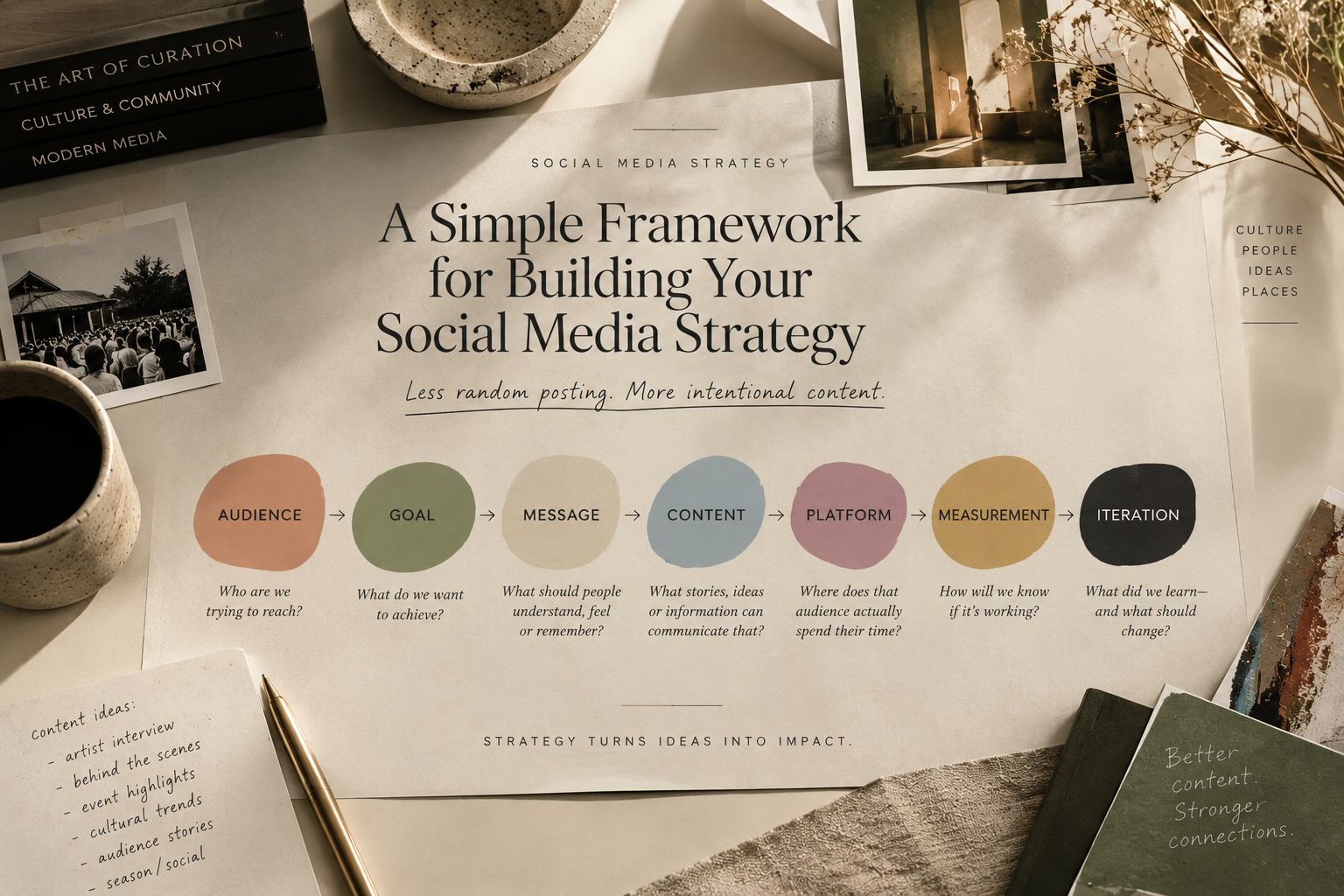
If I had to reduce the entire process to one framework, I’d use:
AUDIENCE
Who are we trying to reach?
↓
GOAL
What do we want to achieve?
↓
MESSAGE
What should people understand, feel or remember?
↓
CONTENT
What stories, ideas or information can communicate that?
↓
PLATFORM
Where does that audience actually encounter this kind of content?
↓
MEASUREMENT
How will we know whether it’s working?
↓
ITERATION
What did we learn—and what should change?
That’s the part people often miss.
A social media strategy isn’t a document you make once and forget about.
It’s a system that evolves.
Final Thought: Don’t Just Build an Account. Build a Reason to Return.
The most interesting social media accounts don’t feel like endless streams of content.
They feel like places.
You know what kind of world you’re entering.
You know what you’ll find there.
And occasionally, something surprises you.
That’s what I want to remember when thinking about social media strategy.
The goal isn’t simply:
Post more.
It’s:
Give people a reason to care.
Then give them a reason to come back.
FAQ
What is a social media strategy?
A social media strategy is a plan for using social platforms to achieve specific goals. It typically defines the target audience, goals, messaging, content pillars, platforms, publishing approach and methods for measuring performance.
What are the main parts of a social media
strategy?
A strong social media strategy usually includes audience research, goals, positioning, content pillars, platform selection, content planning, measurement and ongoing optimisation.
How often should a brand post on social media?
There is no universal number that works for every brand. A sustainable posting schedule is generally more useful than choosing an arbitrary frequency. The right frequency depends on the platform, audience, resources and goals.
What is the difference between content strategy and social media strategy?
Content strategy is broader and concerns what content a brand creates, why it creates it and how that content supports its objectives. Social media strategy focuses specifically on how social platforms are used to distribute content, communicate with audiences and achieve goals.
How do you know if a social media strategy is working?
Measure performance against the original goal. Depending on the objective, this might include reach, engagement, saves, shares, website traffic, leads, sales or community participation.
About the Author
Ameena Chandini is a creative and cultural professional with a background in English Literature and journalism, working across storytelling, editorial, programming, creative projects and digital media. She is interested in how ideas are communicated, how audiences discover creative work and how digital platforms can help connect people with brands, culture and stories.